What Flood Damage Cleanup Actually Involves
Flood damage cleanup is the full restoration of a property after a major water event — not just the extraction phase, but everything through final reconstruction. It covers water removal, controlled demolition of unsalvageable materials, content cleaning and pack-out, antimicrobial treatment, structural drying, mold prevention, and the rebuild that brings your home back to pre-loss condition.
Most homeowners think of flood cleanup as “the wet stuff is gone” — but in IICRC S500 protocols, that's only the first 25% of the job. Real flood cleanup means moisture content in framing returns to dry standard, microbial growth is eliminated or prevented, and every finished surface that has to be replaced is rebuilt to match what was there before. We handle all of it as one continuous project.
Cedar Rapids Has Lived This Twice in Modern Memory
The 2008 Cedar River flood is the defining water event of modern Cedar Rapids history. The river crested at 31.12 feet — more than 11 feet above the previous record — and inundated 1,300 city blocks. Czech Village, Time Check, NewBo, and the entire downtown business district sat under water for days. Recovery took years; some commercial buildings never came back.
In September 2016, the river crested again at 21.95 feet — the second-worst flood in Cedar Rapids history, exceeded only by 2008. Temporary HESCO barrier walls saved the city core from a repeat of 2008, but homes and businesses outside the protection line still flooded. We worked dozens of properties from that event across Time Check, Czech Village, and parts of NewBo.
Even outside major river events, Cedar Rapids deals with flooding constantly: Indian Creek overflow in Marion, sump pump failures across Hiawatha and Robins during heavy storms, and basement seepage through clay-heavy soils every spring thaw. The skills transfer — the same protocols that handle a 2008-style event clean up a Tuesday-night sump pump failure in a finished basement.
Our Flood Cleanup Process
1. Emergency Dispatch and Loss Containment
First call is dispatch within minutes, on-site within 60. The first job is loss containment — stopping the bleeding so the damage stops growing. That might mean shutting off utilities, boarding broken windows, tarping a damaged roof, or simply getting standing water down so it stops spreading into adjacent rooms.
2. Damage Documentation for Insurance
Before anything is moved, our team photographs and video-walks the entire affected area. We log moisture readings, identify the contamination category (Category 1, 2, or 3 per IICRC S500), and create the loss documentation your insurance carrier will require. This step is the difference between a smooth claim and a contested one.
3. Bulk Water Extraction
Submersible pumps for deep water, truck-mounted extractors for finish-out and carpet. See our water extraction page for the equipment specifics. Goal: standing water gone within 2-4 hours of arrival on most residential jobs.
4. Content Pack-Out and Cleaning
Salvageable contents are inventoried, photographed, and either cleaned on-site or moved to our climate-controlled facility for deep cleaning and storage during the rebuild phase. Unsalvageable contents (often Category 3 contaminated upholstery, mattresses, and porous goods) are documented for insurance and removed.
5. Controlled Demolition
Wet drywall is cut to 24 inches above the high-water mark. Soaked insulation is removed. Carpet pad is removed (carpet itself often saved if Category 1 and extracted within 24 hours). Baseboards, trim, and base cabinets are removed if contaminated. The goal: every unsalvageable porous material gone before drying begins, so we're drying the structure, not trying to dry destroyed material.
6. Antimicrobial Treatment
For Category 2 and Category 3 events, exposed framing, subfloor, and remaining surfaces are treated with EPA-registered antimicrobials. This isn't bleach in a spray bottle — it's professional-grade product applied at IICRC S500 specifications to prevent microbial growth during the days-long drying phase.
7. Structural Drying
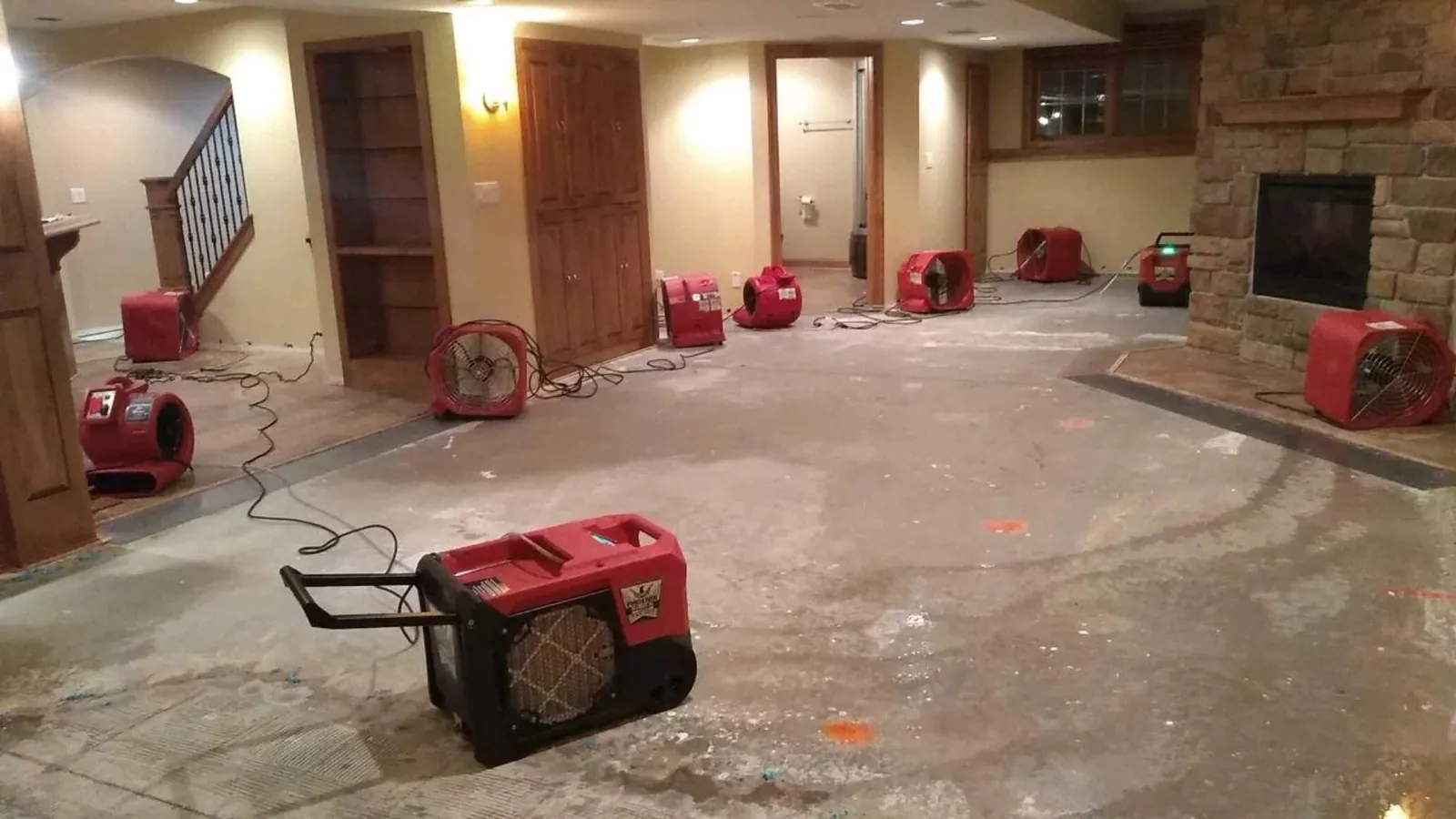
Industrial air movers (typically 1 per 10-16 linear feet of wall) and LGR dehumidifiers run continuously for 3-7 days. Daily moisture readings on framing, subfloor, and remaining drywall confirm progress against IICRC S500 dry standard. We don't leave equipment until readings hit target. More on structural drying.
8. Mold Inspection and Remediation (If Needed)
If water sat more than 48 hours before extraction, or if contamination was Category 3, we conduct post-mitigation inspection for mold. Any growth found is remediated under IICRC S520 protocols before reconstruction begins.
9. Reconstruction
Drywall hung and finished, insulation replaced, flooring laid, trim and baseboard reinstalled, paint applied. We coordinate the full rebuild as part of the same project, so you have one point of contact and one set of insurance paperwork rather than juggling a mitigation company and a separate general contractor.
Signs You Need Flood Cleanup, Not Just Extraction
- Water has been sitting more than 24 hours
- The water source was contaminated (sewage, river, ground)
- Visible high-water marks on drywall above the floor
- Soaked insulation, drywall, carpet pad, or structural members
- Visible mold growth (white, black, green, or fuzzy spots)
- Strong musty smell that doesn't fade with airing out
- Buckled hardwood, swollen baseboards, or warped doors
- Structural concerns — framing that feels soft, ceilings that sag
Cost Factors and Insurance Considerations
Flood damage cleanup in Cedar Rapids typically runs $5,000 – $25,000+ depending on size, contamination level, and rebuild scope. A finished basement with Category 1 water and limited rebuild is on the lower end; a first-floor Category 3 event with full reconstruction reaches the upper range.
Insurance source matters. Internal water damage (burst pipe, appliance failure, supply line break) is covered by standard Iowa homeowners insurance. External flooding from rivers, creeks, or surface water (the 2008 and 2016 Cedar River events) requires NFIP flood insurance — a separate policy homeowners must specifically purchase. We help you identify the applicable policy on your first call so the billing track is clear.
Why Choose Us for Cedar Rapids Flood Cleanup
- Local experience with major flood events — our crews worked the 2016 flood directly and have multi-year experience with Cedar River and Indian Creek flooding patterns.
- End-to-end project management — extraction through reconstruction, one company, one project manager.
- IICRC S500 and S520 certifications — the full protocol stack for water and mold work.
- Direct insurance billing — we work with both NFIP flood policies and standard homeowners carriers.
- Commercial capability — we handle restaurants, retail, and office space along with residential.
Service Areas for Flood Cleanup
We provide flood damage cleanup throughout Cedar Rapids and Linn County, with particular focus on flood-vulnerable neighborhoods including Downtown Cedar Rapids, Southeast Cedar Rapids, Marion (Indian Creek floodplain), and Hiawatha. We also serve Northwest Cedar Rapids, Robins, Ely, and Fairfax.