What Structural Drying Actually Does
Structural drying is the engineered process of removing residual moisture from a building's structural elements — framing, subfloor, drywall, plaster, masonry — after the bulk water has been extracted. It uses high-volume air movement combined with professional-grade dehumidification to drive evaporation and capture the resulting humidity, monitored against the IICRC S500 reference standard for “dry.”
It's the phase between pumping out standing water and rebuilding what was damaged. It's also the phase that's most often shortcut by under-equipped contractors or DIY homeowners — and the phase that determines whether you have a successful restoration or a recurring mold problem in 6 months.
Why Cedar Rapids' Climate Makes Drying Harder
Iowa's seasonal climate creates two distinct challenges for structural drying. In summer (May-September), ambient outdoor humidity often exceeds 70% RH, and the structural drying chamber has to fight against incoming humid air infiltrating through any unsealed openings. We use larger LGR (low grain refrigerant) dehumidifiers in summer specifically because they perform better in already-humid conditions than standard refrigerant units.
In winter (December-February), cold dry air actually helps drying — but only if you can heat the drying chamber enough that the warm air can hold moisture before the dehumidifier captures it. Drying in an unheated Cedar Rapids basement at 35°F is nearly impossible without supplemental heat, because the air doesn't have the capacity to hold evaporated moisture.
Older Cedar Rapids homes — particularly in Czech Village, Time Check, and Bever Park — present additional challenges: stone foundations that constantly contribute groundwater moisture, plaster walls that hold water differently than drywall, and original framing that has likely been wet before and may have embedded surface contamination requiring antimicrobial treatment as part of the drying.
Our Structural Drying Process
1. Initial Moisture Mapping
Before equipment is staged, our lead technician maps the affected area with pin and pinless moisture meters and a thermal imaging camera. We document moisture content readings in framing, subfloor, drywall, and any salvageable finishes. Hidden moisture — water that wicked up wall cavities or traveled along subfloor — is found and recorded. This baseline is the curve we'll dry against.
2. Equipment Calculation and Staging
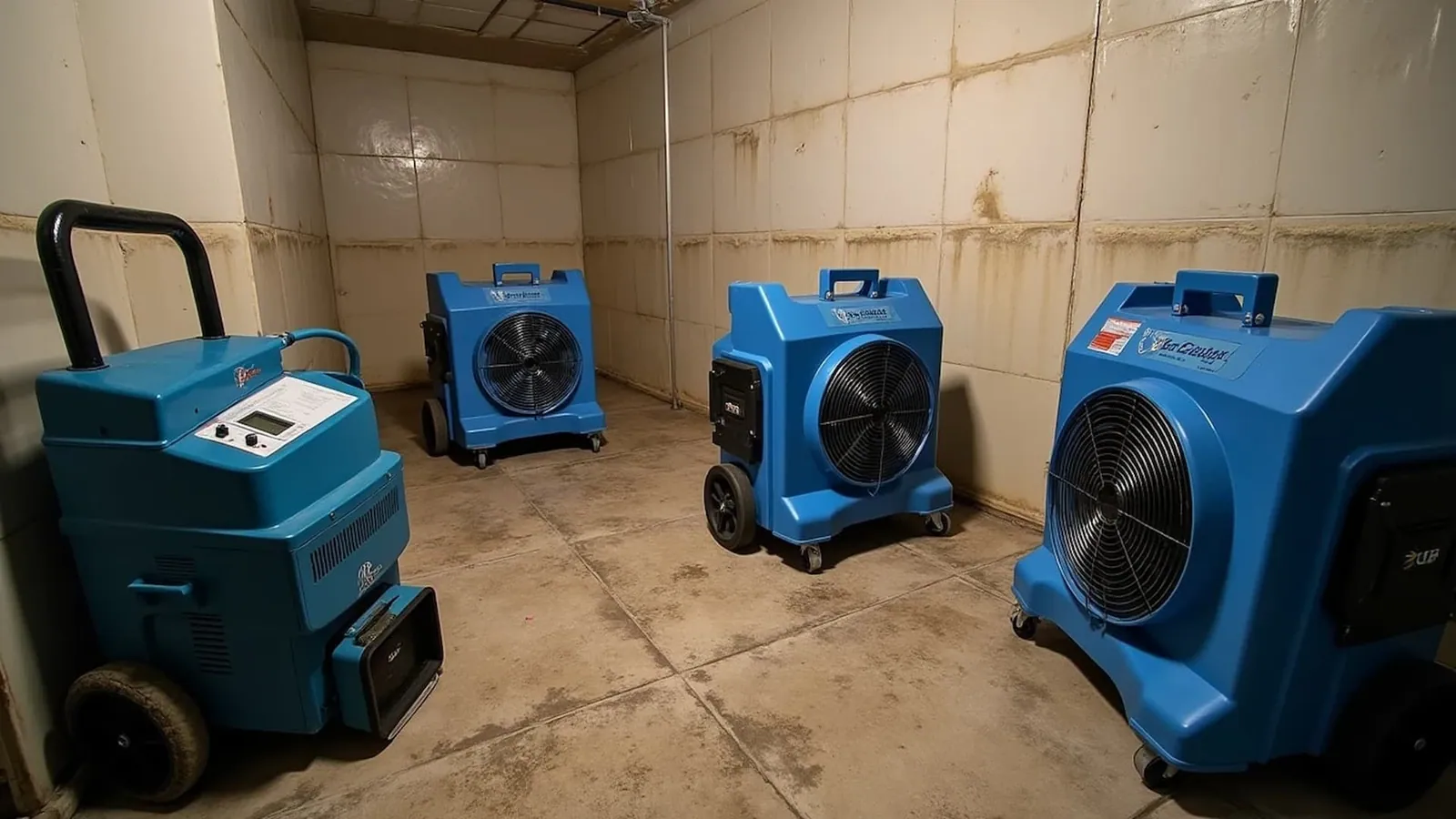
IICRC S500 protocols dictate dehumidifier and air mover quantities based on cubic footage of the drying chamber, water category, and class of loss. A typical residential basement flood (Class 2 — entire room saturated) requires 1 LGR dehumidifier per 1,500-2,500 cubic feet, plus 1 air mover per 10-16 linear feet of affected wall. We stage equipment to spec, not to whatever happens to be in the truck.
3. Containment Where Beneficial
For partial-home losses, we often install plastic containment to seal the drying chamber from the rest of the home. This concentrates the drying effort, reduces equipment needs by 50%+, and prevents drying-area humidity from migrating into unaffected areas (which would otherwise cause secondary damage).
4. Air Movement (Evaporation Phase)
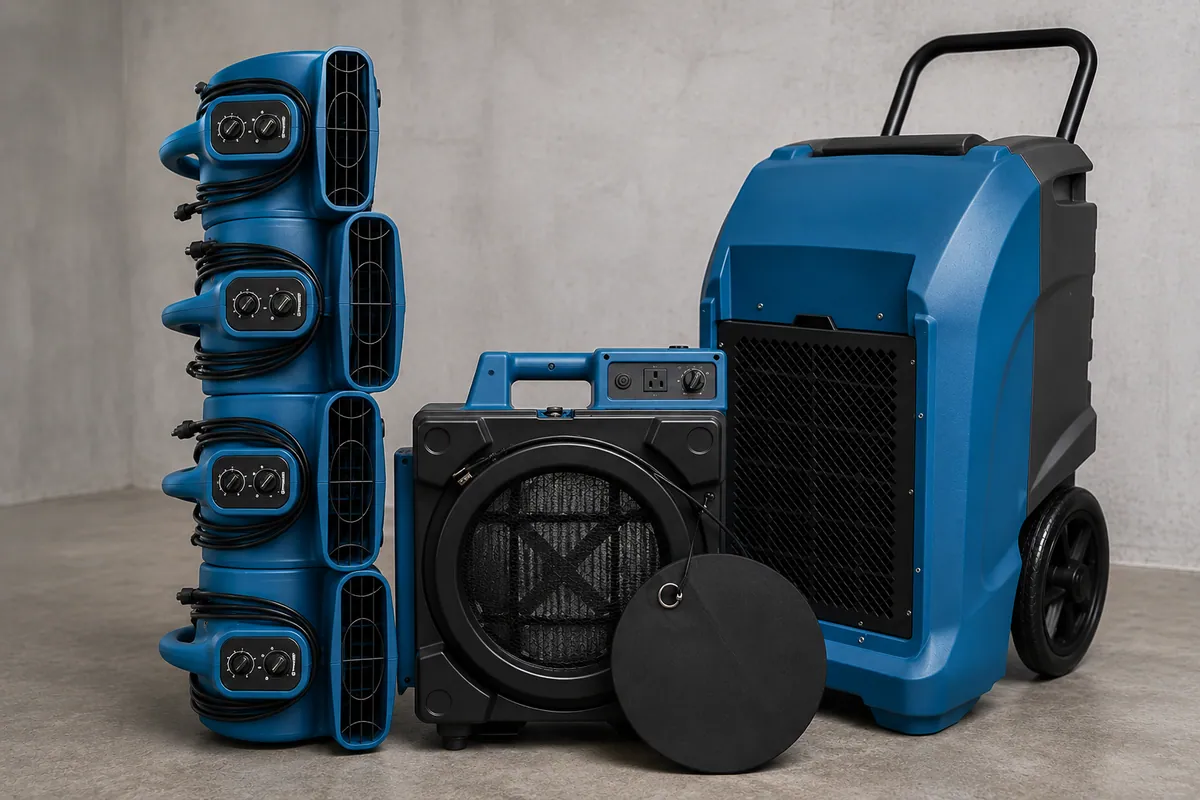
High-velocity air movers (centrifugal “snail” fans and axial fans) are positioned to create boundary-layer airflow across all wet surfaces. The goal is breaking the static air layer that forms against wet materials and inhibits evaporation. Position matters as much as quantity — fans pointed at walls from 18-24 inches away, angled to create a sweep, not a head-on blast.
5. Dehumidification (Capture Phase)
LGR dehumidifiers (typical capacity 130-250 pints/day per unit) capture the moisture being evaporated into the air. Output is dumped via condensate hose to a floor drain, sump, or pumped condensate unit. Modern LGR units include integrated psychrometric monitoring — internal temperature, RH, and grains per pound — which tells us how the drying chamber is performing.
6. Specialty Drying for Hardwood Floors
When hardwood is involved, standard surface drying isn't enough. We use Drymatic-style mat systems that create vacuum suction across the floor surface, pulling moisture up through tongue-and-groove gaps. For severely cupped or buckled floors, we drill ⅛-inch injection holes in the subfloor (covered with decorative caps post-restoration) and force dry air through wall and subfloor cavities directly.
7. Daily Monitoring
A technician returns every 24 hours to take moisture readings, log psychrometric conditions, and adjust equipment as needed. Drying is not “set it and forget it” — chambers go through measurable phases, and equipment placement and quantity needs to change as the drying curve progresses. Daily documentation is also what your insurance adjuster will require as proof of work.
8. Final Verification
Equipment runs until moisture content readings hit IICRC S500 dry standard — typically below 15% MC for wood framing, with comparable readings on drywall, subfloor, and other materials. We don't pull equipment based on day count or homeowner request; we pull it based on readings.
Equipment We Bring to Every Drying Job
- LGR dehumidifiers — Phoenix, Dri-Eaz, or equivalent, 130-250 PPD capacity each.
- Centrifugal air movers — 3,000+ CFM, low-profile design for wall-direction airflow.
- Axial air movers — high-volume open-flow fans for whole-room circulation.
- Hardwood floor drying mats — Drymatic or Injectidry systems for tongue-and-groove vacuum extraction.
- Pin and pinless moisture meters — for verification across substrates.
- Thermal imaging cameras — to find hidden moisture patterns in walls and ceilings.
- Psychrometric data loggers — track temperature, humidity, and dew point inside the drying chamber.
- Containment materials — 6-mil poly, zip doors, tape for sealing the drying chamber.
When Structural Drying Is Necessary
- After any extraction job lasting more than 1 hour
- Following any major water loss, sewer backup, or sump pump failure
- Burst pipes that have wetted framing, subfloor, or drywall
- Roof leaks where moisture entered ceiling cavities or walls
- Appliance failures with water absorbed into surrounding materials
- HVAC condensation issues that have created chronic moisture
- Any time moisture readings exceed IICRC S500 dry standard
Cost Factors and Insurance Coverage
Structural drying is typically billed on a daily equipment-day basis: per dehumidifier-day, per air-mover-day, plus labor for setup, daily monitoring visits, and final teardown. A typical single-room residential drying runs $1,500 – $3,500. A flooded basement with full drying runs $3,500 – $8,000. Major whole-home losses stretch into $15,000+ for the drying portion alone.
Insurance coverage for structural drying is typically included as part of the overall water mitigation claim. Adjusters recognize equipment-day billing as standard industry practice — Xactimate (the software most carriers use to estimate losses) explicitly includes line items for dehumidifier-days and air-mover-days. We provide complete documentation: daily moisture logs, psychrometric readings, equipment placement photos, and daily technician notes. This is what gets claims approved without push-back.
Why Choose Us for Structural Drying in Cedar Rapids
- IICRC S500 ASD-protocol training (Applied Structural Drying) — the reference standard for this work.
- LGR equipment fleet — not standard refrigerant units, which underperform in Iowa summer humidity.
- Daily monitoring with documentation — what your insurance adjuster expects.
- Hardwood specialty drying capability — mat systems and injection drying for floors that look unsalvageable.
- We measure to standard — equipment runs until readings hit IICRC S500, not until the calendar says it should be done.
Service Areas for Structural Drying
We provide structural drying throughout Cedar Rapids and Linn County — Downtown, Northwest, Southeast Cedar Rapids, Marion, Hiawatha, Robins, Ely, and Fairfax.
Structural drying is rarely a standalone job — it's the critical phase that follows water extraction, water damage cleanup, and basement water damage restoration. Done right, it's also what prevents mold remediation from being needed afterward.
More on the drying process itself: how to dry a wet basement properly, and why crawl spaces are harder to dry.