
Basement Waterproofing vs. Water Damage Restoration: Which One Do You Actually Need?
A fair number of the calls we take start with someone asking about waterproofing. A fair number of waterproofing companies in Cedar Rapids take calls from people who actually need emergency drying. Both sets of callers are reasonable — the problem sounds identical from inside the house.
But these are two different trades solving two different halves of the problem, and hiring the wrong one first is how people end up paying for the same wall twice.
The Distinction, In One Line Each
Waterproofing answers: how do I stop water from entering this basement?
Restoration answers: how do I get this water back out of my building materials before they are ruined?
Different questions. Different equipment. Different urgency — and that last one is what decides the order.
What A Waterproofing Contractor Does
Their work is infrastructure, and it is mostly about managing water before it reaches the inside face of the wall.
- Exterior excavation and membrane. Digging down to the footing, applying a waterproof membrane to the outside of the wall, and installing or replacing the perimeter drain tile. The most thorough and most expensive approach.
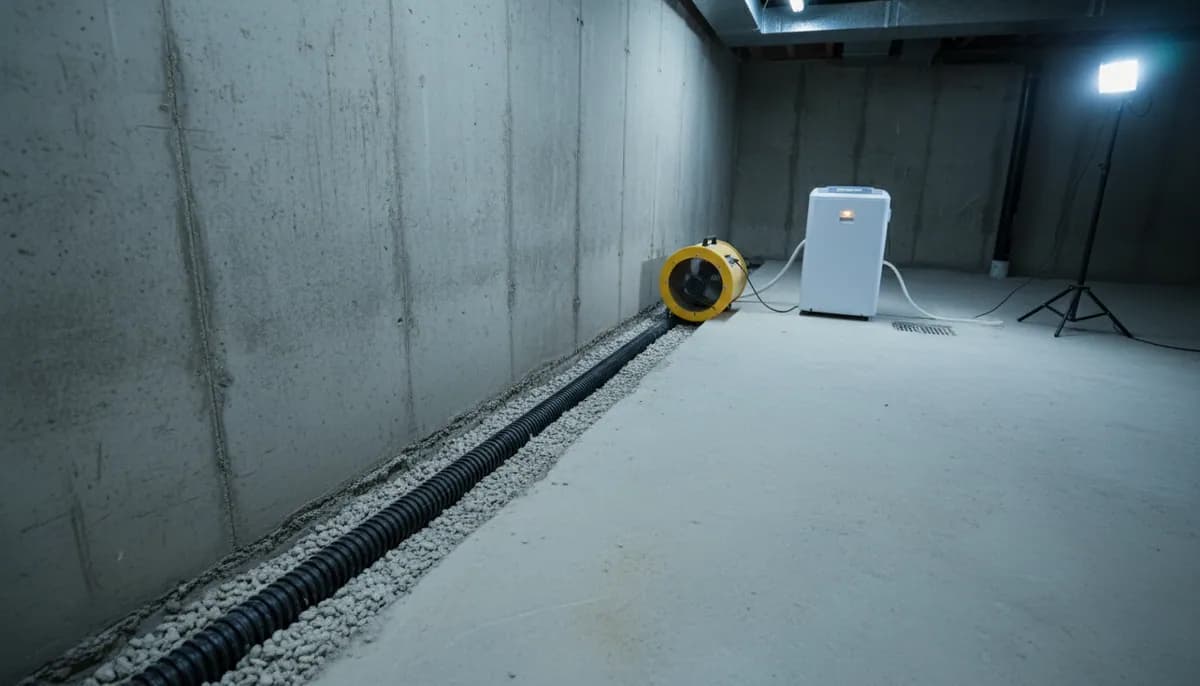
- Interior perimeter drainage. Cutting a channel in the slab at the wall-floor joint, laying drain tile, and routing it to a sump. Manages water that gets through rather than stopping it, but far less disruptive than excavating.
- Sump systems. Pit, pump, discharge line, and increasingly a battery backup.
- Crack injection. Epoxy or polyurethane into a specific structural crack.
- Exterior drainage and grading. The unglamorous, high-value work — regrading, downspout extensions, French drains, window well drains.
Timeline: days to weeks, scheduled. Nothing about it is an emergency. Cost: from a few hundred dollars for grading and downspouts to five figures for full exterior excavation.
What A Restoration Crew Does
Their work is a race against absorption, and it is measured rather than estimated.
- Extraction. Removing standing water and, critically, water held in carpet pad and under flooring — which a shop vac does not touch.
- Moisture mapping. Meters and thermal imaging to find how far water actually migrated inside walls and under cabinets. Water travels much further than the visible edge suggests.
- Controlled demolition. Removing drywall, insulation, and pad that cannot be dried in place — cut to a boundary set by the moisture map, not by what looks wet.
- Structural drying. Air movers and high-capacity dehumidifiers running until framing and concrete reach documented moisture content. Days, monitored daily.
- Antimicrobial treatment where the water was contaminated or dwell time was long.
Timeline: immediate, then three to seven days of equipment. Cost: typically hundreds to a few thousand for a contained loss; more where materials must be removed and rebuilt.
The Order Matters, And Here Is Why
Wet building materials have a clock. Category 1 clean water degrades to Category 2 within about 48 hours. Mold germinates on porous materials in 24 to 48. Drywall that is dried on day one usually stays; drywall still wet on day four usually comes out.
A drainage system has no clock. It will be exactly as effective installed next month as installed this week.
So the sequence is: stop the source, dry the structure, then solve the entry. Installing drainage around wall cavities that have been damp for two weeks means you have built a nice system around a mold problem — and you will be opening those walls again.
Which One Do You Need? A Short Test
Call restoration first if:
- There is standing water, or there was within the last few days.
- Carpet, pad, or drywall is wet to the touch.
- A pipe, appliance, or water heater failed.
- The basement is finished and got wet at all.
- There is any musty smell already.
Call waterproofing first if:
- The basement is unfinished and takes on a thin film of water after heavy rain, which dries within a day.
- You have chronic dampness with no recent event.
- There is efflorescence — white mineral crust — on the walls.
- You are planning to finish the basement and want to solve the moisture before framing goes up. This is the ideal time, and far too few people do it.
Call both if: water came in through the foundation and soaked a finished space. Restoration this week, waterproofing next month, in that order. Our guide to why basements take on water after heavy rain covers the cheap prevention steps worth trying before any large waterproofing spend.
What To Be Careful Of
A restoration quote with no moisture readings. Drying is a measured process. If nobody produced a number for the moisture content of your framing at the start, there is no way to demonstrate it was reached at the end.
A waterproofing quote written without seeing rain. Entry points are far easier to identify during or right after heavy rain. A five-figure interior system proposed on a dry Tuesday, sight unseen in wet conditions, deserves a second opinion.
Interior sealant paint sold as a solution. It has a role after drainage is corrected. It cannot hold back water under hydrostatic pressure, and sold as a primary fix it usually fails within a season.
Either trade recommending the other's work without qualification. Restoration crews are drying specialists — good ones will tell you when the durable fix is a drainage question and refer it out. That is the answer you want.
The Practical Summary
If water is on the floor now, that is a restoration call and it is time-sensitive. If the basement is dry today and the question is about next spring, that is a waterproofing call and you have time to get three opinions.
Doing both, in that order, is what actually ends the cycle. Doing them backwards is how a basement gets rebuilt twice. If you are not sure which situation you are in, call and describe it — that is a two-minute conversation and it will point you at the right trade.