
How Long Does Water Damage Restoration Take? (Cedar Rapids Guide)
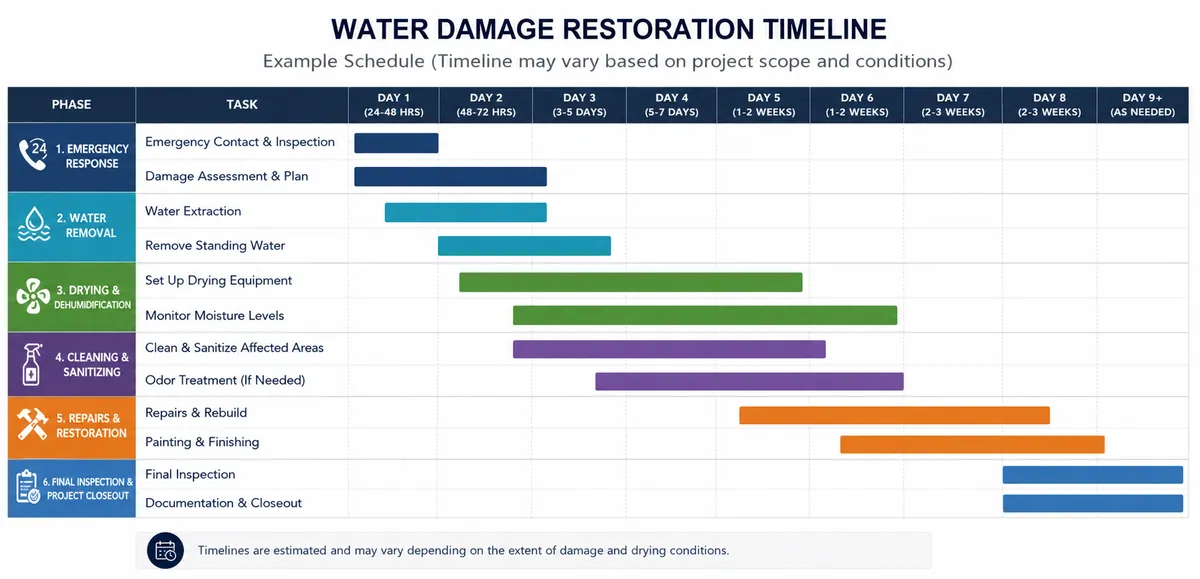
“How long is my home going to be a construction zone?” is the second question every Cedar Rapids homeowner asks after their water damage event — right after “how much will this cost?”. Here are realistic timelines from real projects across the Cedar Rapids metro, broken down by the phases of restoration and the factors that speed things up or slow them down.
The Three Phases of Water Damage Restoration
Most water damage projects involve three distinct phases. Total project time is the sum of all three:
- Mitigation — extraction, demo, drying, antimicrobial
- Mold remediation (if needed) — containment, removal, verification
- Reconstruction — drywall, paint, flooring, trim, cabinets
Mitigation: Days 1-7 Typically
Mitigation is the urgent phase — getting standing water out, removing unsalvageable materials, and drying the structure. Timeline by job size:
Small Single-Room Event: 3-5 Days
A burst supply line in a bathroom, a small dishwasher leak contained to the kitchen, a localized pipe failure caught within hours. Equipment runs 3-5 days; daily monitoring confirms drying progress. Scope is typically one room with adjacent baseboard replacement.
Multi-Room Burst Pipe Event: 5-8 Days
A frozen pipe in a wall affecting two-three rooms. Larger extraction phase, more controlled demo, more equipment. Drying takes 5-7 days for typical scope.
Flooded Basement: 5-10 Days
Sump pump failure, foundation seepage event, or burst water heater. Larger area, often more controlled demo (carpet pad replacement, lower drywall sections), more equipment for more days.
Whole-Floor or Whole-Home Event: 10-14 Days
A significant burst pipe that's cascaded through floors, or extensive contaminated-water events. Mitigation phase alone runs 10-14 days, and that's before reconstruction begins.
Major Loss with Category 3 Water: 7-14 Days for Cleanup Alone
Grossly contaminated water events have additional time built in for containment setup, controlled removal of contaminated porous materials, and verification testing. The actual drying portion may be comparable to a clean-water event of the same scope, but the surrounding cleanup work extends total mitigation time.
Mold Remediation: Days 3-10 (When Needed)
Mold remediation is added to project scope when:
- Water sat more than 48 hours before mitigation began
- The original event was Category 3 (grossly contaminated water)
- Visible mold growth is found during mitigation
- Hidden moisture readings indicate substrate contamination
Mold remediation timeline:
- Small contained area: 3-5 days
- Single-room remediation: 5-7 days
- Whole-basement remediation: 7-10 days
- Whole-home or HVAC contamination: 10-21 days
See our mold remediation page for the full scope.
Reconstruction: Days 7-45+
Once mitigation is complete and dry standard is met, reconstruction begins. This is where total project time varies most widely:
Cosmetic Repair Only: 3-7 Days
Repaint affected walls, replace baseboards, minor trim work. No structural changes.
Standard Reconstruction: 1-3 Weeks
New drywall, mud and tape, paint, baseboards, replacement flooring (carpet, vinyl, or laminate). Most single-room or partial-room rebuilds fit here.
Larger Reconstruction: 3-6 Weeks
Multiple rooms, hardwood floor refinishing or replacement, cabinet replacement, custom trim work, partial or full bathroom rebuild. Most flooded-basement reconstructions.
Major Reconstruction: 6-12 Weeks
Whole-floor reconstruction after major water damage events, full kitchen rebuilds, complex finish work in older homes requiring period-appropriate materials. The longer end applies to cases requiring custom cabinetry or specialty materials with lead times.
Total Project Timelines by Event Type
Putting it all together, here are realistic total project durations for typical Cedar Rapids events:
Small Burst Pipe in a Bathroom: 1-3 Weeks Total
Mitigation 3-5 days, reconstruction 5-15 days. Most homeowners can stay in the home throughout.
Burst Pipe in a Bedroom or Kitchen: 2-5 Weeks Total
Mitigation 5-7 days, reconstruction 10-25 days. Single-room impact; staying in the home is usually feasible.
Flooded Basement: 3-6 Weeks Total
Mitigation 5-10 days, reconstruction 2-4 weeks. Family can usually stay in upper floors throughout, though basement is unusable during the project.
Multi-Floor Burst Pipe Event: 4-8 Weeks Total
Mitigation 8-14 days, reconstruction 3-6 weeks. Displacement often required during peak reconstruction.
Category 3 Event with Major Damage: 6-12 Weeks Total
Cleanup 1-2 weeks, reconstruction 4-10 weeks. Displacement almost always required during cleanup; sometimes during reconstruction as well.
Major Whole-Home Water Damage Event: 2-6 Months Total
Cleanup 2-4 weeks, reconstruction 6-20 weeks. Major displacement is typical, with the full project coordinated through your homeowners claim from mitigation through final reconstruction.
What Speeds Up the Timeline
- Calling within the first hour of damage discovery — every hour of delay extends total project time by 1-3 days due to expanded scope
- Single-vendor mitigation-and-reconstruction — eliminates handoff delays between mitigation contractor and general contractor
- Quick insurance approval — direct billing arrangement and complete documentation accelerate carrier response
- Quick decisions on finish materials — paint colors, flooring choices, replacement fixtures
- Off-the-shelf finish materials — custom orders add weeks to reconstruction
What Slows Down the Timeline
- Delayed mitigation — water that sat for days expands every subsequent phase
- Iowa summer humidity — slower drying, longer mitigation phase
- Older home period materials — sourcing period-appropriate trim, flooring, and cabinetry takes time
- Insurance disputes — back-and-forth on scope or settlement amount delays reconstruction kickoff
- Multi-vendor projects — separate mitigation contractor, plumber, electrician, and general contractor often produce schedule conflicts
- Discovery of additional damageduring demo — common in older homes with hidden issues that weren't apparent in initial assessment
What to Expect Day-by-Day in Mitigation
For a typical residential mitigation project:
- Day 1: Crew arrives, assesses damage, documents loss, begins extraction. Equipment placed by end of day. Containment installed for Category 2/3 events.
- Day 2: First daily monitoring visit. Moisture readings logged. Equipment adjusted as needed. Controlled demo if not completed Day 1.
- Days 3-5: Continued daily monitoring and adjustments. Drying curve should be measurably progressing.
- Days 5-7: Final moisture readings approach dry standard. Equipment teardown when readings hit target.
- Day after teardown: Final inspection and documentation. Coordination with reconstruction phase.
Reconstruction Day-by-Day
For typical multi-room reconstruction:
- Week 1: Drywall hanging, taping, mudding
- Week 2: Sanding, priming, painting
- Week 3: Flooring installation, trim, baseboards
- Week 4: Final paint touch-ups, fixture reinstallation, punch list
For Active Cedar Rapids Restoration Needs
We provide both mitigation and reconstruction as a single project — eliminating the most common cause of timeline delays. See our water extraction, structural drying, and water damage cleanup pages for the technical scope, and our first 24 hours guide for what to do right now.