
Cedar Rapids Flood History: Why Water Damage Preparation Matters
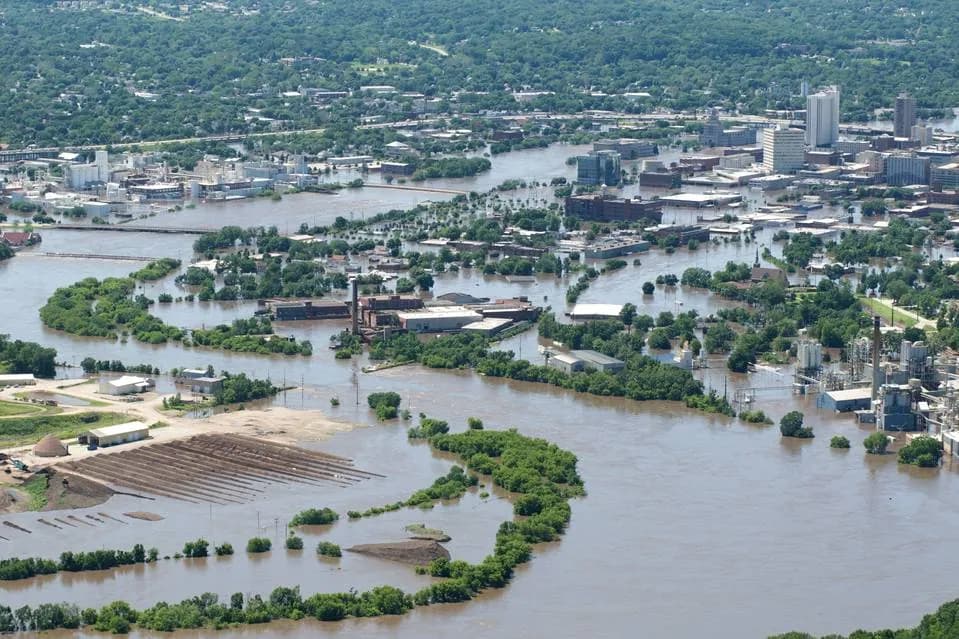
Every Cedar Rapids homeowner should understand the city's flood history — not as an academic exercise, but because the history directly shapes what insurance you should carry, what properties face the highest risk, and what to expect if a major event happens again. The 2008 flood was the largest natural disaster in Iowa history. Sixteen years later, the ramifications are still visible across the city.
The 2008 Flood: Five Hundred Years in Eight Days
On June 13, 2008, the Cedar River crested in Cedar Rapids at 31.12 feet — more than 11 feet above the previous all-time record set in 1929. The flood inundated 1,300 city blocks (roughly 10 square miles), displaced 18,000 residents, damaged or destroyed 5,400 homes and 310 businesses, and forced the evacuation of City Hall and the Linn County Courthouse. National news coverage compared the scale to Hurricane Katrina's impact on coastal cities.
The technical classification was a 500-year flood — meaning a flood of that magnitude has, statistically, a 0.2% chance of occurring in any given year. The reality on the ground was that water reached neighborhoods that had no recorded flood history. Czech Village, Time Check, Cedar Lake, and the entire downtown core were under feet of water for days.
Recovery took years. The Czech Village business district rebuilt. The Time Check neighborhood was largely bought out and converted to greenway. The Five Seasons Center (now Alliant Energy PowerHouse) was rebuilt. The African American Museum of Iowa, the Paramount Theatre, the Public Library — all major civic buildings flooded and underwent extensive restoration. Some businesses never returned.
The 2016 Flood: A Different Test
In September 2016, the Cedar River crested again at 21.95 feet — the second-highest level in city history, exceeded only by 2008. Forecasts initially suggested a possible repeat of 2008, and the city executed the largest emergency evacuation in Cedar Rapids history.
What made 2016 different: temporary HESCO flood barriers, deployed along the riverfront in the days before the crest, held back the river from much of the downtown core. Where 2008 inundated 1,300 blocks, 2016 affected a fraction of that area inside the protected zone. Outside the temporary barriers — Time Check, parts of Czech Village, and lower-elevation residential properties along the river — flooding still occurred and we worked dozens of restoration projects in those neighborhoods.
2016 demonstrated both the value of the city's investment in flood mitigation and the reality that any major Cedar River event still produces significant damage. The temporary barriers worked, but they were temporary.
Indian Creek and Local Flooding
The Cedar River gets the headlines, but Indian Creek has its own history of local flooding. The creek flows through Marion and into the Cedar River, draining a large watershed of agricultural and urban runoff. Heavy rain events — particularly the 2-3 inch overnight rain events common in spring — have historically pushed the creek over its banks into adjacent neighborhoods.
Marion homes near Indian Creek were affected in 2008 along with Cedar Rapids. For day-to-day water damage, though, the calls in these neighborhoods are far more often internal — sump pump failures, burst pipes, and foundation seepage that standard homeowners insurance covers.
What Cedar Rapids Has Done Since 2008
The city's post-2008 flood control investment has been substantial — the largest infrastructure project in Cedar Rapids history. Major elements include:
- Cedar River Flood Control System — a combined levee, floodwall, and removable barrier system along both sides of the river, protecting downtown from events comparable to 2008.
- HESCO barrier deployment capability — the city can deploy temporary flood barriers in advance of forecast events, used successfully in 2016.
- Buyouts and floodplain conversion — Time Check and parts of other vulnerable neighborhoods were bought out and converted to greenway, removing structures from the floodplain.
- Surface-water infrastructure improvements — expanded capacity in surface drainage and combined sewer systems, particularly in older neighborhoods.
- Updated FEMA flood mapping — more accurate floodplain delineation, which directly affects insurance requirements.
Why History Matters for Today's Homeowner
Cedar Rapids' flood history shapes practical decisions for current homeowners:
Insurance Coverage
Standard homeowners insurance covers sudden, accidental internal water damage — burst pipes, frozen pipe failures, water heater ruptures, and appliance overflows — which is the source of the overwhelming majority of water damage claims in Cedar Rapids. Make sure you also carry the sewer-backup endorsement; it's not included by default and covers one of the more common basement loss types.
Property Selection
When buying property in Cedar Rapids, the FEMA flood map and the property's 2008 flood history are essential research. Some neighborhoods (Czech Village edge, Time Check substitute developments, lower NewBo) sit in known flood-prone zones. Properties with documented 2008 damage may have residual issues — always inspect for evidence of past flooding.
Mitigation and Preparation
For properties in vulnerable zones, mitigation investments pay off:
- Sump pump with battery backup or water-powered backup
- Sealed sump pit lid (prevents radon and water vapor entry)
- Sewer backup valve installation
- Exterior drainage improvements (downspout extensions, regrading)
- Elevation of mechanical equipment above the projected flood line
- Flood vents in enclosed areas below grade (allows water to flow through rather than damaging walls)
Documentation Before Damage
Having a thorough record of your home's pre-loss condition makes any future claim substantially easier. Annual photo and video walkthroughs of your home, including contents, give you the documentation that adjusters need when claims are filed.
The Pattern Isn't Over
Hydrologists studying the Cedar River basin point to changing precipitation patterns — more frequent extreme rain events, more rapid snowmelt, more intense rain events — as ongoing risk factors. The 2008 event was statistically rare, but rare doesn't mean impossible, and the recurrence interval may be shortening.
For Cedar Rapids homeowners, the practical implication is simple: the flood history isn't just history. It's the baseline for understanding what your property needs and what insurance to carry. If you've been through a previous event — whether the 2008 catastrophe, the 2016 scare, or one of the smaller Indian Creek overflows in between — the next event is best treated as a question of when, not if.
If You Have Water Damage at Home
For everyday water emergencies — burst pipes, water heater failures, appliance leaks, sump pump failures, and basement seepage — we deploy crews and equipment for a fast emergency response across the metro. See our water damage cleanup page for the full restoration scope and our Iowa insurance claim guide for working through the carrier process.
Reference: The NOAA Cedar River gauge at Cedar Rapids provides real-time and historical river-level data.