DIY vs Professional Water Damage Cleanup: When to Call a Pro
Some water damage events are absolutely a homeowner can handle. Others absolutely require professional restoration. The difference matters because guessing wrong in either direction is expensive — calling pros for a small spill is unnecessary, but DIY-ing a flooded basement turns a $5,000 professional job into a $25,000 mold remediation a year later. This guide draws the line.
The Honest DIY Reality Check
Most homeowners overestimate what they can accomplish with consumer water-cleanup equipment. The math is simple:
- A consumer wet-vacuum recovers roughly 5-10 gallons per hour of standing water.
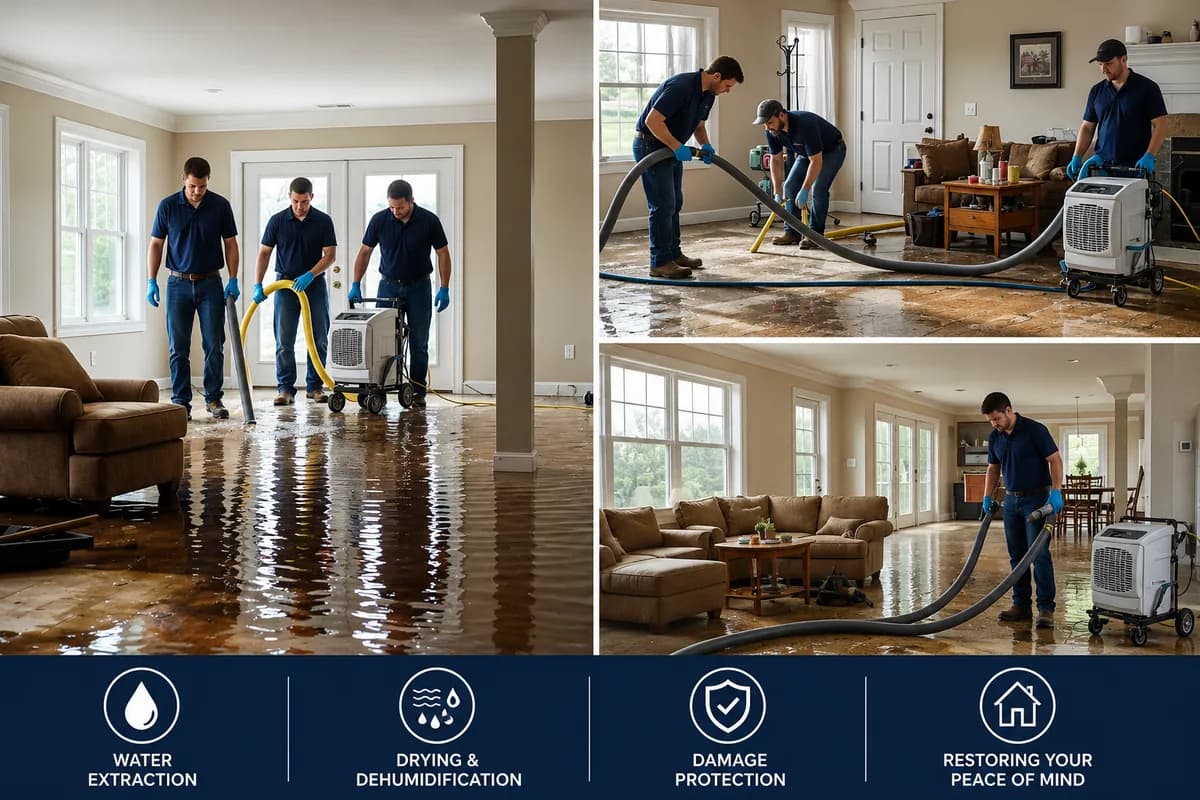
- A truck-mounted professional extractor recovers 200+ gallons per minute.
- A consumer dehumidifier removes ~30 pints per day in ideal conditions.
- An LGR professional-grade dehumidifier removes 130-250 pints per day in challenging conditions.
For very small events, consumer equipment is enough. For anything significant, the difference between consumer and professional capacity is the difference between successful drying and ongoing damage.
When DIY Is Reasonable
All of the following should be true:
- Small affected area — less than 1-2 square feet of standing water, contained to a single surface
- Caught quickly — water sitting less than an hour
- Clean water source — supply line, rain (not flood), accidental spill. Category 1 only.
- Hard surface only— water on tile, sealed hardwood, or finished concrete that hasn't penetrated beyond the surface
- No electrical concerns — water nowhere near outlets or appliances
- Source addressed — the water has stopped flowing
- No structural concerns — no soaked drywall, insulation, or framing
- You have basic equipment — wet-vac, fans, and ideally a dehumidifier
Examples of legitimate DIY events:
- Knocked-over glass of water on tile floor
- Small dishwasher overflow caught in 5 minutes
- Sink overflow contained to bathroom floor
- Toilet overflow with clean water (no solid waste) caught immediately
- Light condensation drip from window during heavy rain
When DIY Becomes Risky
Any of the following pushes the math toward professional restoration:
- Water sitting more than an hour — materials are absorbing rapidly
- Standing water more than 1-2 square feet — beyond consumer extraction capacity
- Carpet or carpet pad affected— pad retains water consumer equipment can't recover
- Drywall, baseboards, or trim wet — requires removal or specialty drying
- Water from any contaminated source — sewer, river, ground, dishwasher with solids, toilet with solids
- Hidden moisture suspected — water that may have wicked into walls or under flooring
- Mold odor or visible growth — even a small amount means substrate contamination
- Electronics, HVAC, or major appliances affected — safety and reuse concerns
- Older home with plaster, hardwood, or original materials — specialty drying capability needed
- Insurance claim is being filed — professional documentation matters
The Hidden Costs of DIY That Goes Wrong
We get called regularly by Cedar Rapids homeowners who tried DIY and ended up with worse problems than the original event. Common scenarios:
The Mold Job That Started as a Burst Pipe
Homeowner extracts visible water with a wet-vac, runs box fans for two days, declares victory. Six weeks later: musty smell, visible mold on baseboard, wall cavity contamination. What would have been a $4,000 water mitigation becomes a $9,000 water + mold project, with substantial out-of-pocket cost because the carrier's mold sub-limit doesn't cover the full scope.
The Hardwood Floor That Couldn't Be Saved
Surface water mopped up, fans pointed at the floor for a few days. Boards cup and never relax flat. Full hardwood replacement at $8-12/sq ft when professional specialty drying within 24 hours could have saved them.
The Carpet That Smells Six Months Later
Wet carpet vacuumed and dried with fans. Pad remains saturated. Months later, persistent musty odor that no amount of cleaning eliminates. Eventual carpet and pad replacement at $4-6/sq ft for the affected area.
The Subfloor That Rotted
Bathroom toilet overflow extracted from surface, but water wicked under the toilet base into the subfloor. Two years later, soft spot under the toilet, eventually rotted through. Major repair to replace the affected subfloor and surrounding flooring.
When You Definitely Need a Professional
Skip the DIY consideration entirely if any of these apply:
- Standing water more than 1-2 square feet
- Water from sewer, river, ground, or other Category 3 source
- Active water intrusion from any external source
- Wet drywall, insulation, or framing
- Visible mold of any size
- Water that's been sitting more than a few hours
- Multiple rooms affected
- HVAC system involvement
- Anyone in the household has respiratory issues
- You're filing an insurance claim
What a Professional Adds Beyond Equipment
It's not just better extractors and dehumidifiers. Professional restoration adds:
- Moisture detectionin places homeowners don't check — wall cavities, subfloor, behind cabinets
- Thermal imaging to find hidden water
- IICRC S500 protocol compliance — structured drying that meets industry standards
- Daily monitoring with documentation adjusters expect
- Direct insurance billing — typically you pay only your deductible
- Antimicrobial treatment for events sitting more than 24 hours
- Coordinated reconstruction if rebuilding is needed
- Liability and warranty — work is warranted, insurance-acknowledged, and documented
The Cost Comparison
For events that legitimately could go either way, the cost math:
- DIY equipment rental: $50-$150/day for wet-vac and fans, $150-$300/day for a professional-grade dehumidifier. Five days of rental: $1,000-$2,250 plus your time.
- Professional small mitigation: $1,500- $3,500 typical, with insurance covering most of it (you pay deductible).
- Professional with insurance covering: your out-of-pocket might be just the deductible — often less than DIY equipment rental costs.
For small events, DIY may save money. For anything beyond the small-event threshold, professional restoration is usually less expensive than DIY when insurance is involved.
The Cedar Rapids Specific Reality
A few local realities that affect the DIY-vs-pro decision in this market:
- Iowa humidity — DIY drying with consumer equipment is much harder in Cedar Rapids summer than in drier climates
- Older home complexity — Czech Village, Bever Park, and similar older neighborhoods have plaster, hardwood, and original materials that require specialty drying
- Spring thaw and rain season— most basement water events here come from sources DIY can't address (groundwater, sump failure, sewer backup)
- Insurance carrier expectations — Iowa carriers generally expect IICRC-certified mitigation for covered claims
The Bottom Line
DIY is reasonable for genuinely small events with clean water and no porous materials affected. For anything beyond that threshold, the cost-benefit math favors professional restoration — particularly when insurance is covering most of it. Erring on the side of professional help for borderline cases is almost always the cheaper long-term decision.
For active emergencies in Cedar Rapids, our 24/7* line connects to our dispatch team for a fast emergency response. No-obligation assessments — we'll tell you honestly if your situation is one you can handle yourself.