
Washing Machine Water Damage: The Most Preventable Loss in Cedar Rapids Homes
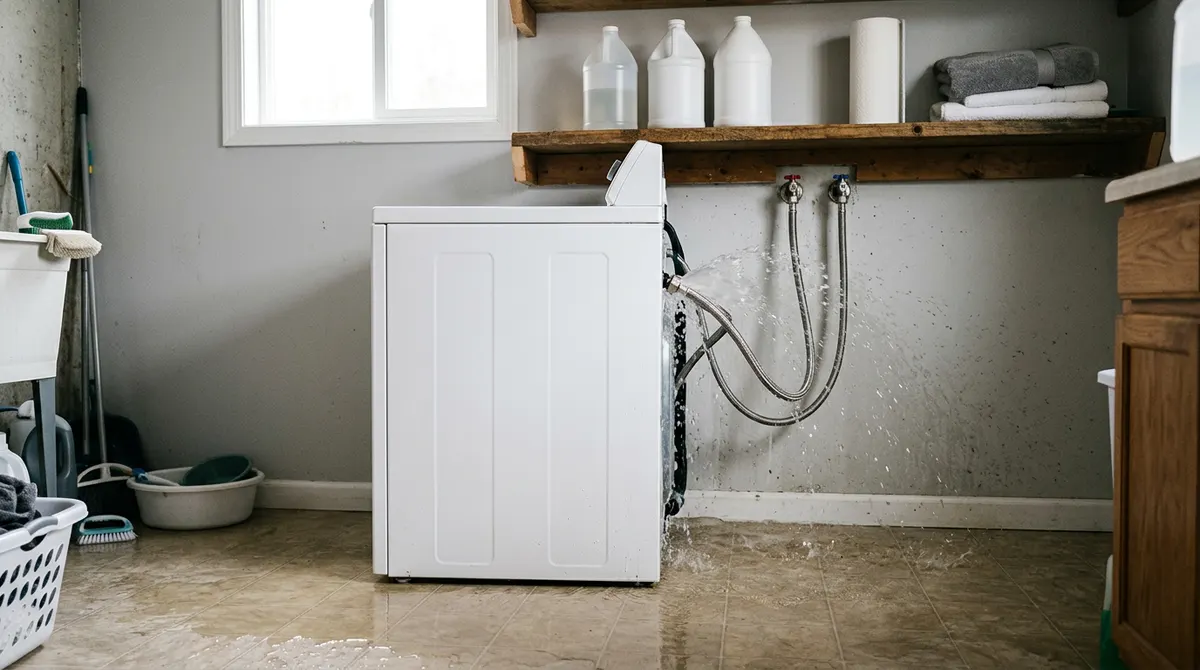
Ask anyone in the insurance industry what causes the most home water damage claims, and washing machine supply hoses are always near the top of the list. It makes sense when you look at the setup: two rubber hoses under constant house pressure, connected twenty years ago, hidden behind a machine nobody moves, shaken by spin-cycle vibration several times a week. In Cedar Rapids homes we see the same pattern over and over — the hose doesn't fail during a load of laundry, it fails at 2pm on a Tuesday when the house is empty.
Why Washer Hoses Fail
- Age. Rubber hoses are rated for about 5 years; braided stainless for 8-10. Most homes are running hoses far past that — often the originals from when the machine was installed.
- Constant pressure. Unlike a faucet, washer hoses hold full house pressure (50-80 PSI) 24 hours a day, whether the machine is running or not.
- Vibration. Every spin cycle shakes the connections. Over years, that works fittings loose and fatigues the hose at the crimp points — which is where most failures happen.
- Kinks and tight clearance. Machines pushed hard against the wall kink the hoses, creating a stress point that ages far faster than the rest of the line.
- Water hammer.The washer's solenoid valves snap shut instantly, sending a pressure spike back up the hose dozens of times per load.
The Warning Signs (Check Yours This Weekend)
Pull the machine forward and look at both hoses — it takes two minutes:
- Blisters, bubbles, or bulges anywhere on a rubber hose — replace immediately; a blister is a burst in progress
- Cracking or stiffness where the hose bends
- Rust or white mineral crust on the fittings or the braid
- Moisture, drips, or mineral tracks at either connection
- A hose you can't remember ever replacing — assume it's past its rated life
If a Hose Has Already Burst: 4 Steps
- Close the supply valvesbehind the washer. If they're seized or inaccessible, shut off water at the home's main valve — our shutoff valve guide shows where to find it in Cedar Rapids homes.
- Kill power to the laundry areaat the breaker if water has reached outlets or the machine's plug.
- Photograph everything — the failed hose, the connections, the standing water, and every affected room — before cleanup starts. Keep the hose for the adjuster.
- Get extraction moving.Laundry rooms sit next to finished space on concrete slabs or above finished basements — water spreads fast into flooring and wall cavities where a shop-vac can't reach it. Our water damage cleanup page covers what full mitigation involves.
Where the Water Goes (It's Worse Than It Looks)
A laundry room floor is rarely the whole story. First-floor laundry rooms drain into the subfloor and down into the basement ceiling below. Second-floor laundry — increasingly common in newer Marion and Hiawatha builds — cascades through the floor system into the rooms underneath, soaking insulation and drywall on the way. And because hose failures so often happen in empty houses, the water gets hours to wick up walls and under flooring before extraction starts. That's the difference between replacing a hose and replacing a ceiling. If moisture sits more than 24-48 hours, mold enters the picture on top of the water damage.
The $30 Prevention List
- Replace both hoses every 5 years(rubber) or per the manufacturer's rating (braided). Write the install date on the hose with a paint marker.
- Leave 4+ inches of clearancebetween the machine and the wall so the hoses don't kink.
- Close the supply valves before any trip longer than a weekend.
- Put a leak sensor on the floor behind the machine — the same cheap alarm we recommend for water heaters.
- Consider an automatic shutoff valve — units that sense flow anomalies or floor moisture and close the supply automatically, worth it for second-floor laundry.
Two Minutes vs. Two Weeks
Checking your washer hoses takes two minutes. Restoring a finished basement after a hose ran for six hours takes two weeks and a five-figure insurance claim. If your inspection finds a blistered hose, swap it this weekend. And if you're reading this standing in water, follow the four steps above — then call, because the clock on saturated drywall and mold is already running.