
Water in Your Crawl Space: Why Cedar Rapids Homes Get It and What It Does to the House
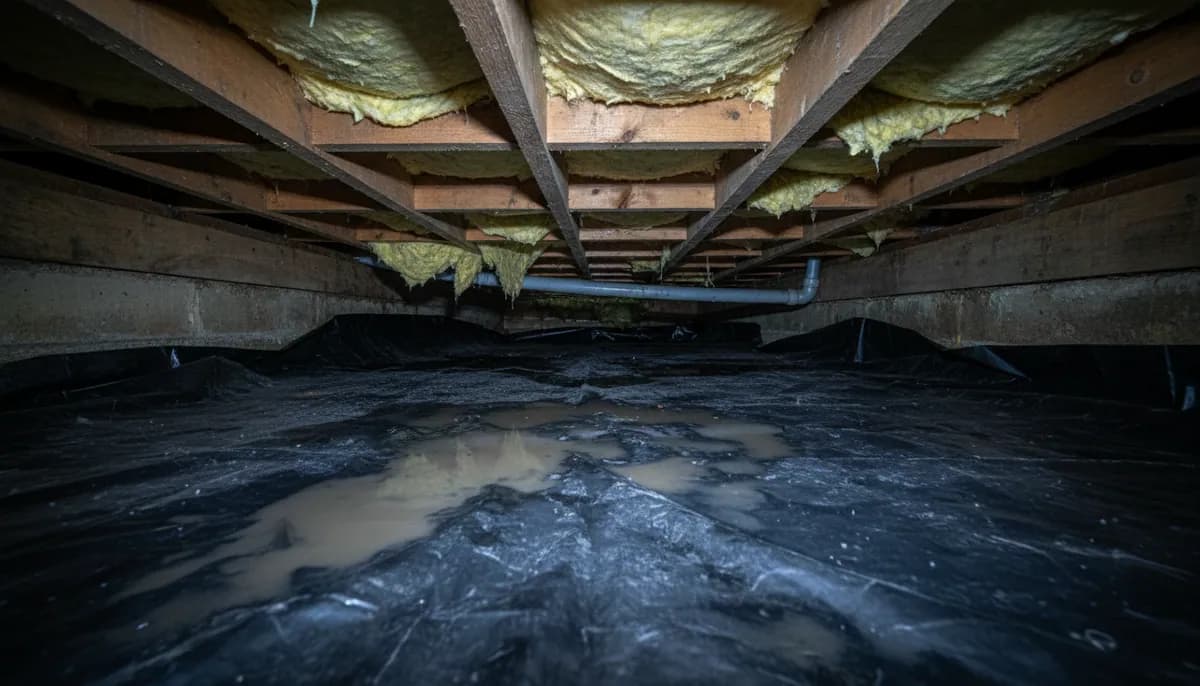
Crawl space water damage has a particular signature: by the time anyone finds it, it is old. Not hours old like a burst pipe in a kitchen, or days old like a basement leak behind a storage shelf. Months. Sometimes years.
The reason is unglamorous. Nobody goes down there. There is no reason to, the access hatch is usually behind something, and the space is uncomfortable in every possible way. So the conditions that would be caught in a week anywhere else in the house get to run unobserved through several seasons.
Where The Water Comes From
In Cedar Rapids homes, five sources account for nearly all of it.
Surface water finding its way in. Grading that slopes toward the house, downspouts discharging at the foundation, or a driveway that drains back toward the crawl. Water sits against the foundation, finds the block joints or the vent openings, and enters. This is the most common cause by a wide margin, and it is the same mechanism described in basements that take on water after heavy rain.
A plumbing line running through the space. Supply lines, drain lines, and water heater connections frequently run through crawl spaces. A slow drip from a fitting has, in that environment, an unlimited amount of time to work. We have found leaks that had clearly been running for over a year.
Groundwater rising through the soil. Where the water table comes up after a wet spring, moisture moves up through unsealed dirt floors by capillary action. There is no dramatic entry point — the ground itself is the source.
Condensation on cold surfaces. Especially in vented crawl spaces during Iowa summers. Humid outside air enters through the vents, meets cool ductwork, cool pipes, and cool foundation walls, and condenses onto them. In a bad July, this alone can put a measurable amount of water into the space with no leak of any kind.
A missing or failed vapor barrier. The polyethylene sheet over the soil is what stops ground moisture evaporating into the space. When it is absent, torn, or laid without overlap, the entire soil surface is a moisture source.
What Standing Water Does Down There
To the structure. Floor joists, girders, sill plates, and subfloor sit directly above the moisture. Wood holds moisture content around 8-12% in normal conditions; sustained crawl space humidity pushes it past 20%, which is the threshold where decay fungi become active. Decay is not mold — it eats the structural fibre of the wood rather than living on the surface. Soft, crumbling, or dark-streaked joist ends are the visible stage of a process that started long before.
To the air upstairs. The stack effect means the house continuously pulls air in low and pushes it out high. A substantial fraction of your ground-floor air originated in the crawl space. Musty smells that seem to have no source, upstairs humidity that will not drop, and allergy-like symptoms that are worse at home frequently trace back to a wet crawl space.
To energy bills and comfort. Wet fiberglass insulation between the joists loses most of its R-value and eventually falls out of the bays. Cold floors above a crawl space in January are usually an insulation-moisture story.
To pests. Damp wood attracts termites and carpenter ants specifically. A moisture problem down there often becomes a pest problem within a couple of seasons.
Signs From Inside The House
You can catch most of this without opening the hatch.
- Musty odour on the ground floor, strongest near floor registers or in closets on exterior walls.
- Cupping or buckling hardwood, particularly in rooms above the crawl. Boards absorbing moisture from below rise at the edges.
- Floors that feel cold or spongy. Cold means insulation has failed; spongy means the subfloor has.
- Indoor humidity that stays high with no obvious cause, or condensation on ground-floor windows.
- Insects appearing indoors in numbers, especially in spring.
Why Crawl Spaces Are Harder To Dry
Everything that makes a crawl space unpleasant also makes it technically difficult.
Clearance is often under three feet, which means equipment has to be small, placed by hand, and repositioned by someone lying down. Airflow is naturally poor, so the passive drying that helps in a basement barely happens here. The soil itself is a reservoir that keeps re-supplying moisture unless it is sealed. And access frequently means a hatch too small for a standard dehumidifier.
A proper dry-out means extracting standing water, removing saturated insulation and any failed vapor barrier, running low-profile air movers and dehumidification long enough to bring joist moisture content back to normal, monitoring with meters rather than by feel, and treating any growth already established on the framing. It is closer to structural drying work than to cleanup.
Keeping It Dry Afterwards
- Extend downspouts at least six feet from the foundation. Cheapest, highest-return item on this list.
- Correct the grade so soil falls away from the house — roughly six inches over the first ten feet.
- Install a proper vapor barrier — 6-mil minimum, overlapped and run up the foundation walls, not just laid loose on the dirt.
- Consider encapsulation with sealed vents and a dedicated dehumidifier. In an Iowa climate this consistently outperforms traditional venting.
- Inspect twice a year. Put it on the calendar with the furnace filter. Ten minutes with a flashlight in spring and autumn catches almost everything on this page while it is still small.
The Part Worth Repeating
Crawl space problems are never urgent and always expensive, which is a bad combination for how people actually behave. There is no dramatic moment that forces action — just a slow decline in the wood holding your floor up, and air quality upstairs that gets a little worse each year.
If you have found water under the house, or you have a musty ground floor and have never looked, that inspection is worth doing now. Call and we will assess what is actually happening down there and what it has already reached.