
Attic Mold in Cedar Rapids Homes: Why It Starts Up There and What It Takes to Fix
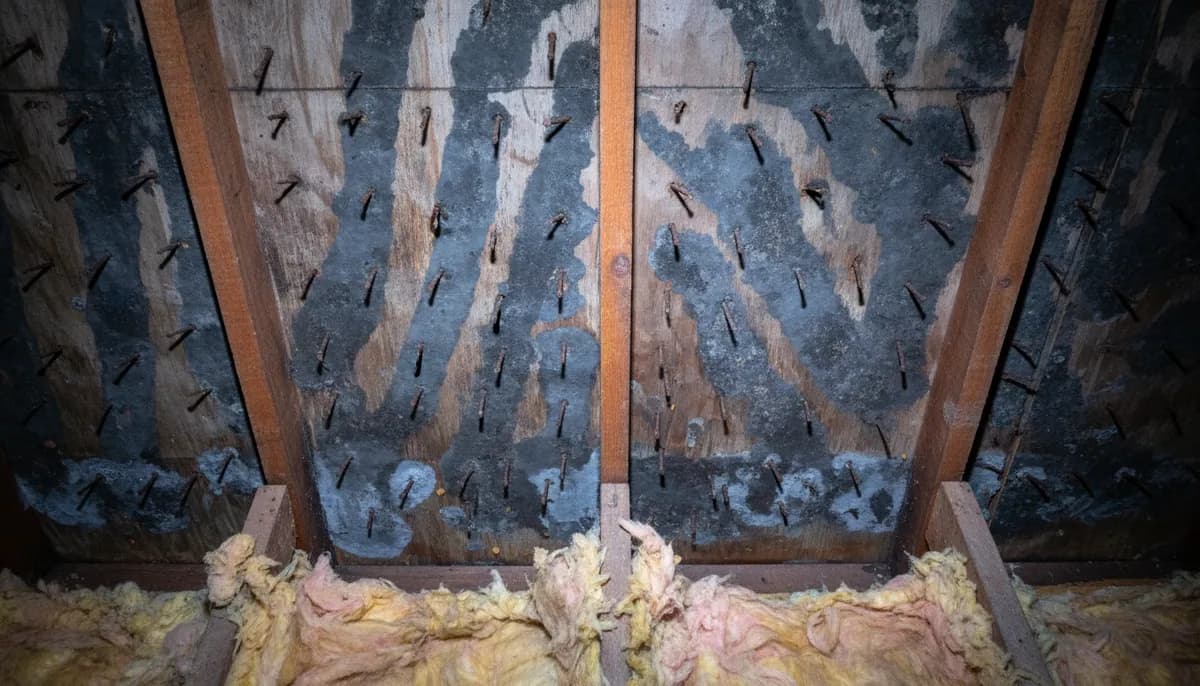
Almost everyone who finds mold in their attic assumes the roof is leaking. It is the intuitive conclusion — dark staining on the underside of the roof deck, therefore water came through the roof.
In Cedar Rapids, that is usually wrong. Most attic mold we look at has nothing to do with the roof at all. It is condensation, generated inside the house, deposited on cold sheathing every winter night for years. Which matters a great deal, because cleaning it without fixing the cause means it comes back.
How Iowa Winters Make Attic Mold
The mechanism is simple physics and it runs all winter.
Your living space produces water vapour constantly — showers, cooking, laundry, dishwashers, breathing, houseplants. A family of four puts several gallons of moisture into the air every day. Warm air holds that vapour comfortably. Warm air also rises, and it leaks upward through every unsealed penetration in your ceiling: the attic hatch, recessed lights, bath fan housings, plumbing stacks, wiring holes, the gap where the top plate meets drywall.
That warm, moist air reaches an attic where the roof sheathing is sitting at outdoor temperature — which in a Cedar Rapids January means well below freezing. The vapour hits a surface far below its dew point and condenses, often as frost. Come the next sunny afternoon, the frost melts into the wood. Then it refreezes. All winter.
Plywood or OSB sheathing that is repeatedly wetted, with organic material to feed on and no meaningful airflow, grows mold. Every single time.
The Three Failures Behind It
Inadequate ventilation. An attic needs balanced intake at the soffits and exhaust at or near the ridge, so outside air continuously washes the underside of the deck and carries moisture out. The most common defect we find is soffit vents blocked by blown-in insulation — someone added insulation depth without installing baffles, and the intake half of the system stopped working. Exhaust with no intake does very little.
Air leakage from the living space. The moisture has to get up there in the first place. Unsealed attic hatches, non-airtight recessed cans, and open framing cavities are the usual routes. Sealing these is often more effective than adding ventilation, because it addresses supply rather than removal.
Bath and kitchen fans venting into the attic. This one is astonishingly common in Cedar Rapids homes, particularly where a bathroom fan was added years after construction. The duct terminates in the attic instead of through the roof or soffit, and every shower pumps a concentrated column of warm humid air directly at the sheathing. When you see localised heavy growth in one spot rather than general staining, look for a fan duct pointed at it.
What It Looks Like
- Dark grey or black streaking running with the grain of the plywood, heaviest between rafters and concentrated on the north slope.
- Frost on nail points in winter — the tips of roofing nails protruding through the deck are the coldest spots and frost first. Frost on nails is the early warning before staining appears.
- Compressed, damp, or discoloured insulation near the eaves, which also means it has stopped insulating.
- A musty smell when the hatch opens, or on the upper floor during humid weather.
- Sheathing that feels soft or shows delamination — that is past the mold conversation and into a structural one.
A leak looks different: it is localised, it follows a path downward from a specific penetration (chimney, vent boot, valley), and there is usually staining on the framing below it. Condensation staining is diffuse and follows the cold surface, not gravity. Telling those apart is the first thing an assessment establishes — related reading: roof leaks and interior water damage.
What Remediation Involves
Attic work follows the same IICRC S520 sequence as any other space, with a few attic-specific realities:
- Fix the moisture first. Baffles installed and soffits cleared, exhaust corrected, bath fans ducted to the outside, ceiling penetrations air-sealed. If this does not happen, everything after it is temporary.
- Containment at the hatch. The attic access gets sealed with negative pressure inside so that removal work does not push spores down into the house.
- Remove contaminated insulation. Blown-in insulation that has been repeatedly wetted holds growth and cannot be cleaned. It comes out by vacuum.
- Clean the sheathing. HEPA vacuuming plus either abrasive methods (soda or dry ice blasting on larger jobs) or antimicrobial treatment. The goal is removal of growth, not bleaching the colour out of it.
- Encapsulate, optionally. After cleaning, a sealant can be applied to the deck. This is a finishing step, never a substitute for the four above.
- Re-insulate. New insulation to current depth, with baffles kept clear this time.
Prevention, Which Is Most Of The Answer
- Confirm every bath and kitchen fan terminates outside the building envelope, not in the attic. Look for the duct; follow it.
- Check that soffit vents are open and not buried. From inside the attic at the eaves, you should see daylight.
- Weatherstrip and insulate the attic hatch. It is the single largest ceiling air leak in most houses and costs very little to fix.
- Run bath fans for 20 minutes after showering, on a timer if nobody remembers.
- Look at your attic twice a year — once in deep winter for frost, once in late spring for staining.
Worth Doing Before It Is Structural
Attic mold is slower and less urgent than a wet basement, and that is exactly why it gets ignored until a home inspection forces the issue. The cost curve is real though: cleaning stained sheathing is a manageable job, replacing delaminated sheathing is a roofing project.
If you have found staining up there, the useful next step is establishing whether it is condensation or a leak, because the fix is completely different. Call and we will assess it properly — and if the same house also has moisture downstairs, mold after water damage covers the below-grade half of the picture.