
What Mold Remediation Costs in Cedar Rapids — and What Actually Moves the Price
Mold remediation pricing has a reputation for being opaque, and honestly, it earns some of that. Two contractors can walk the same Cedar Rapids basement and come back with numbers that differ by a factor of three — not because one is gouging you, but because they are describing two different jobs.
This is what you are actually paying for, and the five variables that move the number more than anything else.
The Range, Honestly
For residential work in the Cedar Rapids metro, most jobs sit in these bands:
- Small, contained, non-structural — growth on one section of wall from a known short-duration leak, under about 30 square feet. Roughly $800-$2,000.
- Moderate — a section of finished basement where water sat several days, requiring drywall and insulation removal along a run of wall. Roughly $2,000-$5,000.
- Extensive — a finished lower level where the moisture went undetected for weeks, multiple walls, flooring, and possibly HVAC involvement. Roughly $5,000-$12,000+.
Per-square-foot figures get quoted a lot (commonly $10-$25), and they are close to meaningless on their own. A 40 square foot patch of surface growth on sealed concrete costs a fraction of 40 square feet of growth behind insulated, finished wall. Square footage tells you almost nothing about what has to come out.
What Is Actually In The Price
A complete remediation scope has six cost centres. When you compare quotes, you are really comparing which of these the contractor included.
- Assessment and moisture mapping. Meters and thermal imaging to establish how far the water actually travelled, which sets the demolition boundary. Scoping this badly is how jobs get done twice.
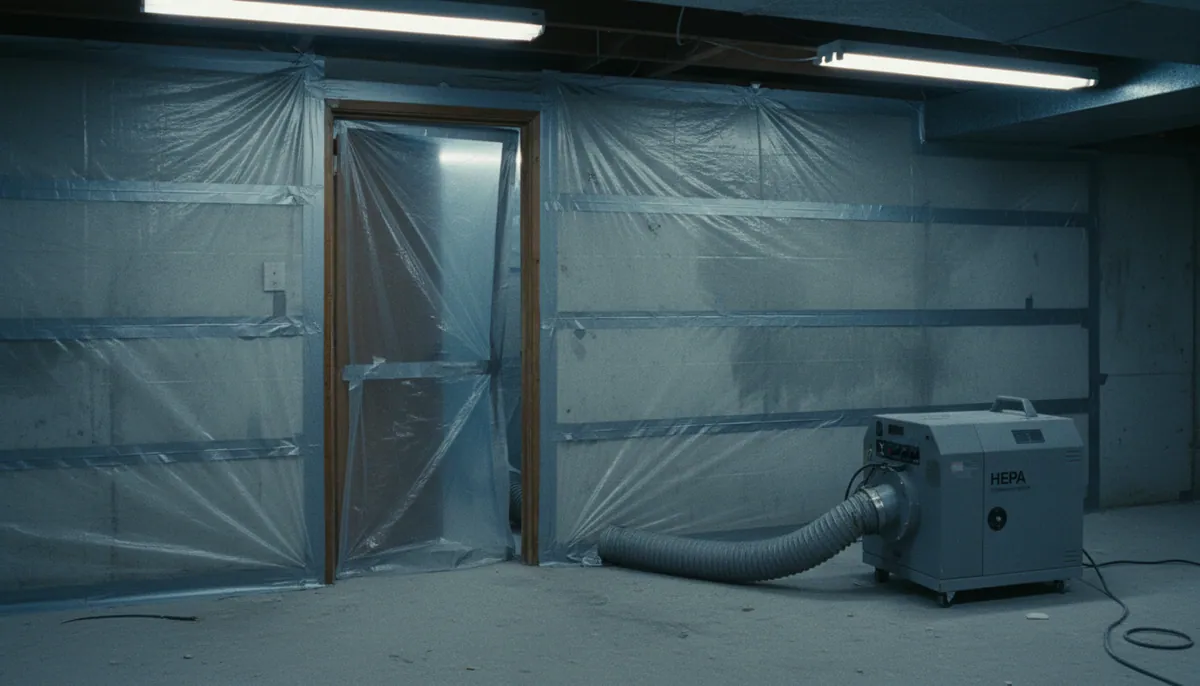
- Containment. Poly sheeting, zipper doors, and negative air machines with HEPA filtration so that disturbing growth does not seed the rest of the house. Materials plus setup labour. This is the line most often missing from a cheap quote.
- Removal and disposal. Cutting out affected drywall, insulation, carpet pad, and trim; bagging it inside containment; hauling it. Priced by volume of material, not by area of visible growth.
- Cleaning of what stays. HEPA vacuuming and antimicrobial treatment of framing, subfloor, and concrete. Labour-intensive and slow on complex framing.
- Drying. Air movers and dehumidifiers on site for several days, priced per unit per day, until framing and masonry hit documented moisture targets.
- Verification. Visual clearance at minimum; post-remediation air sampling by a third party if the claim or the buyer requires it. Sampling typically adds a few hundred dollars.
The Five Things That Move The Number Most
1. How much porous material has to come out. This dominates everything else. Growth on painted concrete gets cleaned. Growth on paper-faced drywall over fiberglass batts means both come out, plus the trim, plus whatever flooring runs under the wall. Two jobs with identical visible growth can differ by thousands based on what is behind it.
2. Whether the house is occupied. Containment in an empty house is a few sheets of poly. Containment in a house where a family is living upstairs means sealed pathways, protected egress, daily setup and teardown, and air scrubbers running continuously. It is a real and legitimate cost difference.
3. Access. A walkout basement with a wide door is straightforward. Carrying bagged material up a narrow turn-back staircase, through a finished living room, adds hours to every load. Crawl spaces are worse again — see crawl space water damage for why.
4. Whether HVAC is involved. If the air handler or ductwork sits in the affected space and ran while growth was active, the system has to be addressed too. This is a meaningful add and it is not optional — an untreated system redistributes the problem to every room in the house.
5. How long it sat. The one variable you control. Material that has been wet for two days dries. Material that has been wet for two weeks is removed. That distinction is the difference between a drying invoice and a demolition-and-rebuild invoice.
Where Insurance Sits
Iowa homeowners policies generally follow the water, not the mold. If the mold grew from a sudden and accidental discharge — a burst supply line, a failed water heater — remediation is often covered, though many policies apply a specific mold sublimit (commonly $5,000-$10,000) well below the dwelling limit. If the mold grew from long-running seepage, a chronic humidity problem, or deferred maintenance, expect it to be excluded.
Practical consequence: the cause and the timeline are what get evaluated, so document both. Photograph the source, note when you found it, and keep the invoice from whoever repaired it. More detail in our Iowa water damage claim guide.
Reading A Quote Properly
Four questions separate a scope you can compare from one you cannot:
- What material is being removed, and to what boundary past the visible growth?
- How is containment being established, and is negative air included?
- What is the drying target, and how is it measured and documented?
- Does this include reconstruction, or does it stop at clean and dry?
A quote that answers all four is worth comparing on price. A quote that answers none of them is not a quote, it is a number.
The Cheapest Mold Job
It is the one that never happens. Water that gets extracted and dried inside the first day or two does not become a remediation project — nothing is demolished, nothing is contained, nothing is rebuilt. Every large invoice we write started as a small drying job that somebody decided could wait a few days.
If you have visible growth now, call and we will scope it properly rather than quote a square-foot rate over the phone. If you have water now and no growth yet, that is the more valuable call — and how drying actually works explains why the next 48 hours matter so much.