
How to Dry a Wet Basement Properly (and the Point Where DIY Stops Working)
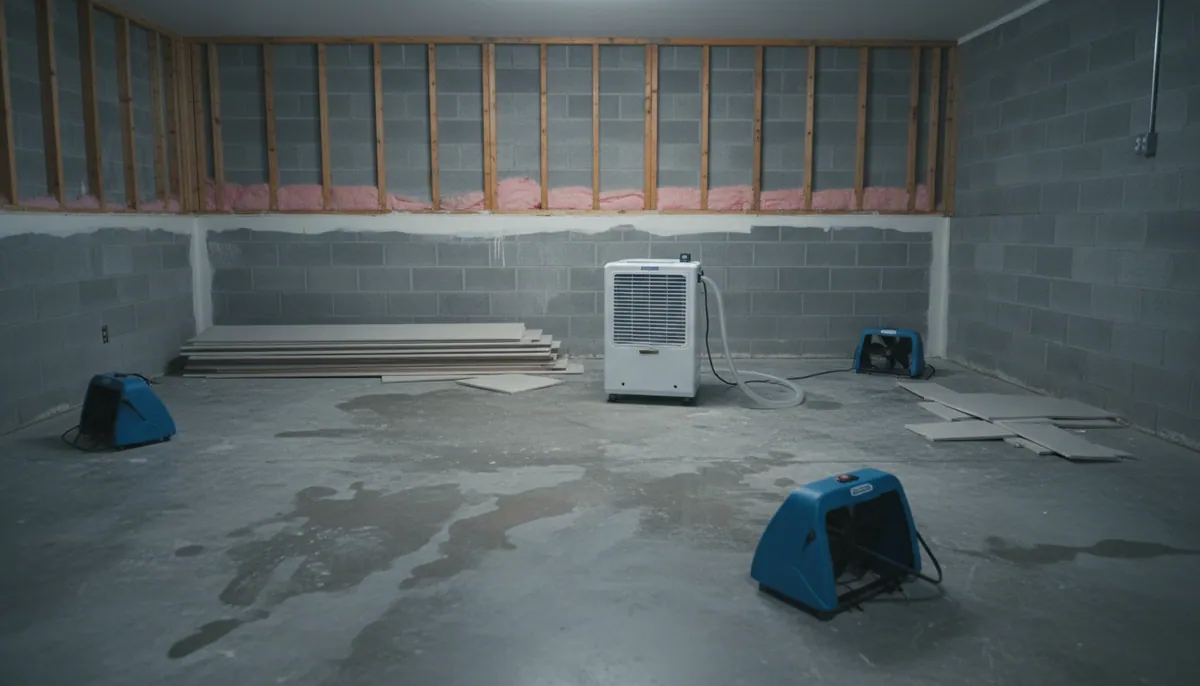
Drying a basement is one of those jobs that looks finished long before it is. The floor stops being shiny, the air stops smelling wet, everything feels normal — and there is still water in the bottom of the drywall, in the sill plate, and in the top inch of the slab.
That gap between looks dry and is dry is where most basement mold comes from. Here is the sequence that actually works, and the honest point at which renting a fan stops being enough.
Step 1 — Stop The Water And Kill The Power
Nothing below matters while water is still arriving. If the source is plumbing, close the main. If it is coming through the foundation, that is a drainage problem and it will keep supplying water for as long as the ground is saturated.
Power to the wet level off, at the panel, before anyone walks in. If the panel is in the water, do not touch it.
Step 2 — Remove Standing Water Fast
Every hour that standing water sits, more of it moves into materials that are much harder to dry than a floor.
- Under two inches: a wet/dry shop vac works. Expect to empty it many more times than you anticipate.
- Over two inches: a submersible utility pump, discharged well away from the foundation so it does not simply come back.
- Carpet: pull the pad. Do not try to dry it in place — it is a sponge sitting between the carpet and the slab, and it prevents everything underneath from evaporating.
Step 3 — Get Wet Contents Out
Cardboard, paper, upholstered furniture, and anything porous stored on the floor act as reservoirs — they hold water and release it slowly back into the room, which extends drying time for the whole space. Move them out entirely, not to the other side of the basement.
Take photos before anything moves if there is any chance of an insurance claim.
Step 4 — Open The Cavities That Are Wet
This is the step DIY drying almost always skips, and it is the reason DIY drying so often fails.
Water wicks upward through drywall by capillary action — commonly 12 to 24 inches above the water line, sometimes further. Behind that drywall is insulation holding water and framing absorbing it, in a sealed cavity with no airflow. You can run fans in that room for a week and change nothing inside the wall.
What has to happen:
- Pull the baseboards. Non-destructive, fast, and it opens the bottom of the cavity.
- Drill or cut inspection holes low on the wall so air can enter the cavity, or cut a flood cut — a clean horizontal removal of drywall above the water line.
- Remove wet fiberglass insulation. Once saturated it does not recover its R-value and it holds moisture against the framing indefinitely.
- Lift flooring that traps moisture — vinyl plank, laminate, and sheet vinyl all seal water against the slab beneath them.
Step 5 — Airflow Plus Dehumidification, Together
Drying is evaporation followed by removal. Both halves are required, and doing one without the other is the second most common mistake.
Air movers push high-velocity air across wet surfaces to break the saturated boundary layer and accelerate evaporation. Point them at low angles along walls and floors, not into the middle of the room. A household box fan moves far less air than a professional air mover, but it is better than nothing.
Dehumidifiers remove the moisture that evaporation just put into the air. Without one, you have simply relocated the water from the floor into the room air, where it will condense back onto the coolest surfaces — which in a basement is the foundation walls.
Close the space. Doors and windows shut so the dehumidifier is working on a defined volume of air rather than the whole outdoors. This is counter-intuitive and it is correct.
Target: relative humidity between 30% and 50%. A $15 hygrometer tells you where you are and whether you are winning.
The Iowa Summer Trap
Worth its own heading, because it catches people every year.
The instinct after a wet basement is to throw the windows open. In a Cedar Rapids July, outdoor air is often 80°F at 70% relative humidity, carrying a great deal of moisture. Let that into a basement where the walls and slab sit around 60°F, and the air cools, its capacity drops, and the moisture condenses onto your foundation.
You have added water while feeling productive. Check a hygrometer inside and out before opening anything — in winter the outside air is usually genuinely drier and ventilation helps; in humid summer weather it usually does not.
Step 6 — Verify With A Meter, Not A Hand
Wood framing normally sits around 8-12% moisture content. Above roughly 16% and held there, decay and mold become viable. Concrete holds water far longer than it appears to and will keep releasing it into the room air for days after the surface looks dry.
A pin-type moisture meter is inexpensive and it converts this from guesswork into a number. Take a reading in an unaffected area of the same material as your baseline, then read the wet area daily. When they match and stay matched for a day, you are done. Until then you are not, regardless of how it feels.
Where DIY Stops Working
Being straightforward about it — call for professional structural drying when any of these are true:
- The basement is finished. Drywall, insulation, and framing in sealed cavities cannot be dried with rental equipment. This is the single clearest line.
- The water sat more than 24-48 hours. You are past prevention and into a mold containment question.
- The water was contaminated — a drain backup, or anything that ran through soil.
- It covers more than a couple of hundred square feet. Rental dehumidifiers are sized for comfort, not for pulling water out of a structure.
- The smell has not gone after drying. Odour is moisture that is still there.
- You intend to file a claim. Documented moisture readings and a drying log are what an adjuster actually pays against.
The Practical Version
Stop the water. Pull the pad and the baseboards. Open wet cavities. Air movers and a dehumidifier together, doors closed, for several days. Measure, do not guess.
Do that within the first day and most Cedar Rapids basements dry without incident. Skip the cavity step, or start on day four, and you have moved from a drying job to a remediation job — which costs several times more. If you are looking at a finished basement that got wet, that call is worth making today rather than after the smell arrives.